

What makes an OpenText support budget justification difficult to approve is often not the amount requested, but unclear ownership of the work. In a production estate, platform operations, database administration and business administration may sit with different teams. Reviewers then need to understand what the budget covers, where hand-offs occur and which operational needs the request addresses.
Broad claims about risk or savings rarely make the case stronger. Use evidence from your own estate, such as incident records, recurring work, maintenance history, staffing arrangements and ownership documentation. Separate measured facts from assumptions, then connect each proposed responsibility to a defined support scope.
This article sets out how to build that case, compare support models using consistent criteria and identify practical next steps. The aim is a request reviewers can trace to operational need, without overstating financial returns or service commitments.
Why does an OpenText support budget need an operational case?
A support request is hard to assess when nobody can say who owns the work. Platform operations may sit with one team, database administration with another, and business administration with people who understand the workflows but not the underlying estate. A clear OpenText support budget justification makes those boundaries visible instead of relying on general statements about risk.
We define a budget justification as a record of four things: the estate’s documented needs, the support scope requested, the people or teams accountable for each task, and the evidence that will be reviewed. This gives budget reviewers a request they can trace. It also separates continuity planning from claims that support will prevent a particular loss or guarantee savings. Unless your own records substantiate those claims, present them as possible outcomes, not proven returns.
A production estate needs support for the operational responsibilities required to keep its platform, underlying database and business administration owned, maintained and reviewable.
What evidence should support an OpenText budget request?
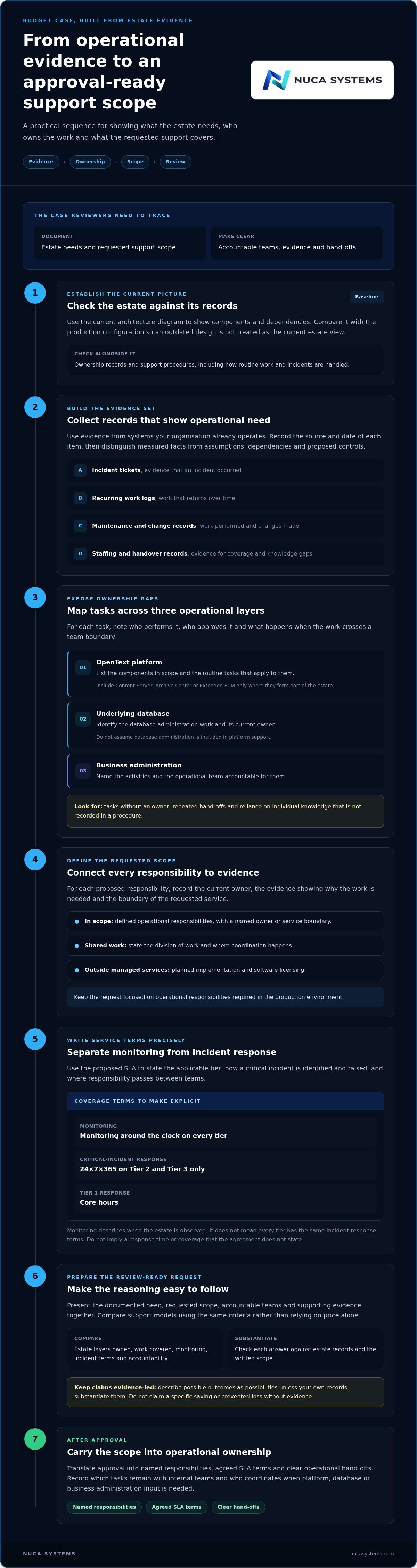
Start with the estate as it is operated today. Use the current architecture diagram to show components and dependencies, ownership records to identify responsible teams, and support procedures to explain how routine work and incidents are handled. Compare the diagram with the production configuration so an outdated design document is not mistaken for a current view.
Next, gather records from systems your organisation already uses: incident tickets, recurring work logs, maintenance records and change records. Note the source and date of each item. Separate measured facts from assumptions, dependencies and proposed controls. A ticket can establish that an incident occurred; a concern about what might happen if an administrator is unavailable needs supporting staffing or handover records before it can be presented as an evidenced gap.
How do you explain the cost of unclear ownership?
Map recurring and incident tasks across the platform, database and business administration. For each task, record who performs it, who approves it and what happens when it crosses a team boundary. Look for tasks without an owner, repeated hand-offs and reliance on individual knowledge that is not recorded in a procedure.
Describe the operational exposure without inventing a financial loss. A task with no named owner can delay diagnosis; a hand-off without an agreed escalation route can leave teams waiting on one another. Check each concern against evidence such as ticket timestamps, escalation notes, rota or ownership records, and procedure reviews. The result is a case for defined accountability, not an unsupported claim about a specific saving.
Which OpenText support needs belong in the budget case?
Once you have documented the estate’s gaps, translate them into specific responsibilities. Keep the scope tied to what is present and required in your production environment. Include Content Server, Archive Center or Extended ECM only where they form part of your estate. Include monitoring, incident handling, patching and upgrade readiness where there is a defined operational need.
For each proposed responsibility, record the current owner, the evidence showing why the work is needed, and the boundary of the requested service. This helps distinguish ongoing estate stewardship from project work. Planned implementation and software licensing should sit outside a managed-services justification, keeping the OpenText support budget justification focused on operational responsibilities.
Which OpenText estate responsibilities should be costed separately?
Separate the work into three operational layers. For the OpenText platform, list the components in scope and the routine tasks that apply to them. For the database underneath it, identify the administration work and its current owner rather than assuming it is included in platform support. For business administration, name the activities and the operational team currently accountable for them.
Then document the boundaries. If a platform incident requires database or business-administration input, show where the hand-off occurs and who coordinates it. Where responsibilities are shared, describe the division of work. A support request is clearer when it states which tasks stay with internal teams and which fall within the proposed service.
How should monitoring and incident response appear in scope?
Write monitoring and incident response as separate service terms, and state the exact coverage for each tier of the proposed service. Monitoring describes when the estate is observed. It does not mean every tier has the same incident-response terms.
Set out the applicable tier, how a critical incident is identified, how it is raised and where responsibility passes between teams. Use the proposed SLA to define those terms. Do not imply a response time or level of coverage that the agreement does not state.
How do you compare OpenText support models without relying on price alone?
Compare what each model makes your organisation responsible for, not just the budget line. Apply the same questions to internal-only support, separate specialist arrangements and a single-SLA service: who owns each estate layer, what work is covered, how monitoring operates, which incident terms apply, and how predictable the recurring commitment is? Check every answer against your estate records and the written scope.
What should an OpenText support comparison table include?
Use the table as a working comparison, not a verdict. The internal-only and fragmented columns describe common arrangements, so replace them with your actual team responsibilities and service terms. Record exclusions, escalation boundaries and tasks retained by internal teams. A blank or unclear answer is a scope question to resolve, not evidence that a model is cheaper or less effective.
| Model | Ownership | Covered layers | Monitoring | Incident terms | Budget predictability |
|---|---|---|---|---|---|
| Internal-only | Assigned across internal platform, database and business teams, if documented | Set by internal procedures and staff responsibilities | Record the tools, hours and estate components actually monitored | Use internal escalation and response arrangements | Reflects approved staffing and operational commitments; check how cover is maintained |
| Fragmented specialists | Divided between internal owners and separate specialist teams | Defined separately in each agreement | Compare monitoring scope and identify any gaps between arrangements | Record each escalation route and the terms that apply at hand-offs | Review recurring commitments and any separately managed work |
| Single SLA | One accountable service boundary across the agreed scope | Can cover platform, underlying database and business administration | State the agreed monitoring coverage for each tier | Use the specific response terms in the SLA | A fixed monthly fee provides a predictable recurring commitment for the defined scope |
When does a single SLA make budget ownership clearer?
A single SLA can put responsibility for the platform, the database underneath it and business administration within one documented service boundary. This makes it easier to identify who coordinates work when an incident crosses layers. Separate teams and specialists can also work effectively; make their hand-offs and internal responsibilities visible rather than assuming they create a problem.
Nuca Systems’ managed services use one SLA covering the OpenText platform, the database underneath it and business administration. The service has three depths, Tier 1, Tier 2 and Tier 3. Monitoring runs around the clock on every tier; critical-incident response 24×7×365 applies to Tier 2 and Tier 3; Tier 1 responds in core hours. Compare those terms with your incident requirements and the scope in the SLA. Base the budget case on operational fit and your organisation’s evidence, not on a general claim about which model costs less.
How can you turn estate evidence into an approval-ready budget request?
Make the request easy to test. A clear OpenText support budget justification connects each requested activity to an observed need, a responsible owner and an agreed review point. We use four steps: establish the baseline, document gaps, define the scope, then ask for a specific decision.
- Establish the baseline: record the production estate, components, dependencies, current owners and procedures.
- Document gaps: use incident, workload and maintenance records to show where responsibilities or processes are incomplete.
- Define the scope: state the proposed tier, SLA boundaries, included work and responsibilities retained internally.
- Request a decision: identify the approving owner, the decision required and the date your organisation needs it.
Keep the evidence compact. Each row should let a reviewer trace an observation to its source and proposed action.
| Source | Date | Owner | Observed issue | Proposed action |
|---|---|---|---|---|
| Incident record, maintenance log or ownership procedure | Record the source date or review period | Name the responsible team or role | State what the record shows, without adding an unsupported cause | Link the requested activity to the evidence |
What should an OpenText support budget request contain?
Summarise the estate scope, operational responsibilities and evidence behind each requested activity. Include the proposed tier and SLA boundaries, plus tasks that remain with internal teams. State when the arrangement will be reviewed and which evidence will inform that review, such as incident records, recurring workload or changes to the estate and its ownership.
How can technical teams explain uncertainty to finance?
Label observed facts, possible exposure and incomplete evidence separately. An incident count shows recorded incidents, not savings or losses avoided. Use financial inputs from your organisation, and mark estimates and assumptions for finance review rather than presenting them as measured results. Name dependencies plainly, including internal owners, service boundaries and any approval assumptions.
Close the request with review criteria, accountable owners and a decision date set by your organisation. This gives finance a defined proposal and gives operational teams a clear basis for checking whether the approved scope still fits.
What should happen after the OpenText support budget is approved?
Approval starts the operational work; it does not complete the budget case. Translate the approved scope into named responsibilities, SLA terms and clear hand-offs. If a Content Server incident needs database investigation, for example, the agreed process should identify who leads, who supplies evidence and when responsibility passes between teams.
How should the approved support scope be recorded?
Record the production estate and components covered, the service tier, accountabilities, exclusions and retained internal responsibilities in the agreed SLA. Set out how incidents are raised and escalated, and how routine work such as monitoring, patching and upgrade readiness is handled where it forms part of the approved scope. Keep change implementation and software licensing as separate workstreams, outside the managed-services description.
Agree how your organisation will review the evidence and scope, including who owns the review and which records will inform it. If the review refers to a product version or version-specific requirement, check the relevant OpenText release notes and record the version assessed. This keeps the operating agreement grounded in the estate being run.
When is managed support or interim cover relevant?
Managed services are available at three depths, Tier 1, Tier 2 and Tier 3, so the agreed scope can reflect the estate’s needs and internal ownership. One SLA covers the OpenText platform, the database underneath it and business administration, which makes the agreed service boundary clear.
Interim cover is relevant when operational ownership needs temporary continuity during a specialist vacancy or transition. It has a three-month minimum, then rolling monthly. Record its purpose, hand-over arrangements and responsibilities in the approval documentation.
The Estate Continuity Review covers two weeks and five senior days, with a fixed price agreed before work starts and credited against subsequent work. Record its findings against the estate evidence and use them to clarify operational ownership and scope.
Make the support case operational
A defensible OpenText support budget justification links evidence from your estate to clear scope, named owners and review criteria. It distinguishes measured operational needs from assumptions and does not present possible risk reduction or savings as guaranteed outcomes.
Compare support models against the same criteria: ownership across the platform, database and business administration, monitoring arrangements, incident terms and retained internal tasks. If you select managed services, document the agreed tier and SLA boundaries. Nuca Systems has 14+ years of experience on Content Server, Archive Center and Extended ECM. One SLA covers the OpenText platform, the database underneath it and business administration.
Documented responsibilities and evidence give budget approval a practical route to an operating arrangement, rather than another unclear hand-off. Book a 45-minute continuity check call to discuss ownership and support scope for your estate.
Frequently asked questions
Related reading