

What if a slow OpenText ECM service isn’t a database problem at all? A sluggish response, failed process or growing backlog can point to the database, the application or the infrastructure beneath them. OpenText ECM database administration starts with separating those symptoms from their causes, not reaching for an isolated SQL fix.
When responsibility is split between database, platform and supplier teams, that distinction can be hard to make. Each hand-off can add time, while routine care slips when operational demands take over. The database and ECM platform still need to operate as one service, with clear ownership across the boundary.
This article explains what database administration covers in ECM operations and how to investigate problems methodically. You’ll see how to follow evidence across the database, application and infrastructure, and how to assign responsibility for ongoing production care. The aim is practical: fewer assumptions during incidents, fewer gaps in routine maintenance and a clearer view of what keeps the service reliable.
What OpenText ECM database administration covers in production
OpenText ECM database administration is the ongoing care of the database layer that supports an ECM service, including monitoring, capacity, access, maintenance and recoverability. It goes beyond SQL performance tuning. Tuning may address a particular query or workload; administration also covers the controls and routine work that keep the data layer dependable over time. The wider Database administration remit includes areas such as security, configuration, performance, backup and recovery.
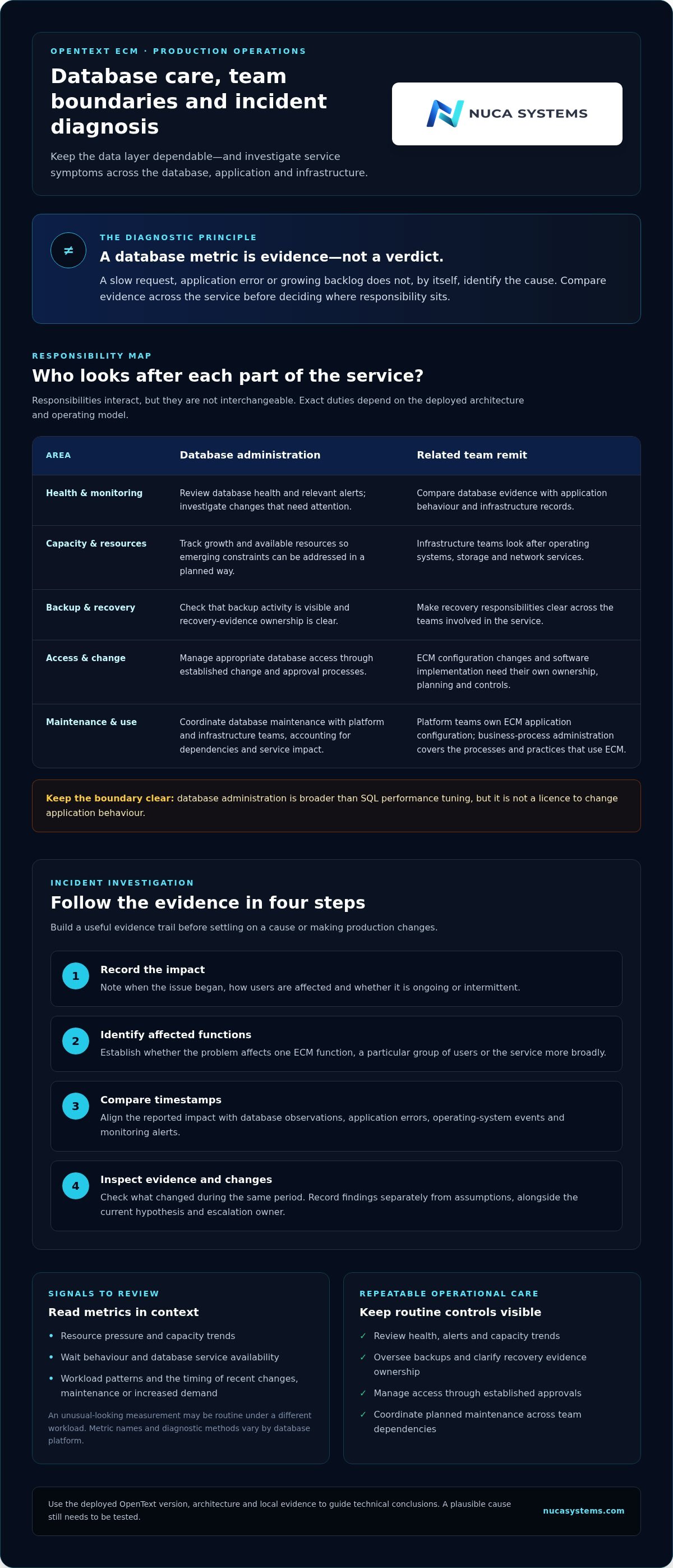
In production, the database is one part of a larger service boundary. The database administrator looks after database health and works with other teams when an issue crosses that boundary. ECM application configuration belongs to the platform remit; operating systems, storage and network services sit with infrastructure teams; business-process administration concerns the processes and practices that use ECM. These responsibilities interact, but they are not interchangeable.
Which responsibilities sit with the database administrator?
Exact duties depend on the deployed architecture and operating model. A practical remit commonly includes:
- Monitoring: Review database health and relevant alerts, then investigate changes that need attention.
- Capacity: Track growth and available resources so emerging constraints can be addressed in a planned way.
- Backup oversight: Check that backup activity is visible and that ownership of recovery evidence is clear.
- Access controls: Manage appropriate database access through the organisation’s established change and approval processes.
- Planned maintenance: Coordinate database maintenance with platform and infrastructure teams, accounting for dependencies and service impact.
These are operational disciplines, not a licence to change application behaviour. Routine administration is distinct from ECM configuration changes and software implementation work, which need their own ownership, planning and controls.
Where the OpenText application and database meet
ECM requests depend on the database being available and returning data responsively. If that dependency is slow or unavailable, users may experience delays or errors. But an application error doesn’t prove the database is at fault. The cause may lie in application configuration, infrastructure, connectivity or another part of the service.
That boundary matters during diagnosis. Treat a database metric as evidence, not a verdict. Compare it with application behaviour and infrastructure records, using the deployed OpenText version and architecture to determine which evidence is relevant. Don’t assume a particular database arrangement or product behaviour without checking the environment.
How to diagnose OpenText ECM database symptoms without guessing
A slow request is an observation, not a diagnosis. Effective OpenText ECM database administration depends on collecting evidence across the service before deciding where the fault sits. Correlated records from the database, application and infrastructure provide stronger evidence than any single metric.
Use a repeatable sequence:
- Record the impact. Note when the issue began, how users are affected and whether it is ongoing or intermittent.
- Identify affected functions. Establish whether the problem affects one ECM function, a particular group of users or the service more broadly.
- Compare timestamps. Align the reported impact with database observations, application errors, operating-system events and monitoring alerts.
- Inspect relevant evidence. Check what changed during the same period, then record findings separately from assumptions.
This sequence helps teams avoid turning a plausible cause into a premature conclusion. It also gives the next team a useful evidence trail instead of a vague report that “the database is slow”.
Which database signals should administrators review?
Review signs of resource pressure, capacity trends, wait behaviour and database service availability. Compare them with normal workload patterns and the timing of recent changes, such as maintenance or increased demand. A measurement that looks unusual in isolation may be routine under a different workload. Confirm metric names and interpretation against the deployed database platform, as labels and diagnostic methods vary.
ECM service health also depends on sound operational practices beyond database metrics. TechTarget’s ECM deployment best practices offer broader context for managing an ECM environment. Use platform-specific documentation and local evidence to guide technical conclusions.
How to distinguish database pressure from an ECM-layer issue
Compare who is affected, which functions fail and when symptoms occur. If one function errors whilst others remain responsive, that pattern is useful evidence, but it doesn’t prove the application is at fault. Check whether the same time window shows database pressure, application errors or infrastructure events. Record the evidence, current hypothesis and escalation owner before making production changes.
Keep the distinction clear: “requests timed out during this period” is an observation; “the database caused the timeouts” is a hypothesis to test. Where teams share support, a joined review of database and OpenText records can reduce repeated hand-offs. Nuca Systems’ managed OpenText operations bring database, platform and business-process administration under one SLA.
Routine OpenText ECM database controls that prevent avoidable incidents
Routine controls won’t prevent every incident. They do make silent drift easier to spot and reduce avoidable surprises. In OpenText ECM database administration, the value comes from repeatable work: clear ownership, recorded evidence and reviews that continue even when operational teams are busy.
Useful disciplines include regular capacity reviews, backup oversight, recovery validation, controlled access and planned maintenance. Monitoring should show changes over time, not just generate alerts that nobody reviews. Agree who checks each control, where results are recorded and how exceptions are raised.
Backups, recovery readiness and database capacity
A completed backup is evidence that a backup task ran. It isn’t, by itself, evidence that the service can be restored. Recovery validation tests whether the documented recovery approach works in the relevant environment and helps expose gaps in responsibilities, access or dependencies.
Tested recovery procedures give teams better grounds for confidence when restoring service.
Capacity reviews should track database growth and available headroom against business demand and applicable retention requirements. Look for trends and unexpected changes, then agree what action is needed before pressure becomes an incident. Backup frequency and retention periods should reflect the environment’s requirements and recovery objectives, rather than being copied from a generic checklist.
Maintenance, access and change control
Privileged access needs an owner. Keep access documented, controlled and aligned with operational responsibilities, so permissions remain understandable when staff or suppliers change. Review changes through the organisation’s established approval process and retain enough evidence to explain what changed and why.
Database maintenance and patching also need coordination. Plan the work with the teams responsible for the OpenText platform and supporting infrastructure, taking dependencies, change windows, validation and the route to recovery into account. Don’t treat a database patch as an isolated task if it could affect the wider service.
Before making version-specific recommendations, verify that the proposed database version and patch combination is supported for the deployed OpenText environment. Compatibility depends on the actual configuration, so avoid relying on assumptions or guidance written for a different estate.
A short, repeatable review can keep these controls visible:
- Are capacity trends and monitoring evidence being reviewed?
- Is backup oversight distinct from recovery validation?
- Are access and maintenance responsibilities documented?
- Are patch dependencies and approvals recorded before work begins?
These checks don’t remove operational risk. They make the state of the database easier to understand and make routine care less dependent on memory or individual availability.
How to make OpenText ECM database administration sustainable
Reliable operations depend on more than resolving the latest incident. OpenText ECM database administration becomes sustainable when the estate is documented, responsibilities are assigned and routine evidence is reviewed rather than gathered only after something fails.
A practical handover from diagnosis to ongoing operations
Use a handover to turn incident findings into working operational knowledge. Record the architecture and dependencies, who owns access, known risks and current procedures. Include open incidents, recent changes and the evidence that helped diagnose them. Keep the record usable: an accurate map and clear contacts are more valuable than documentation nobody maintains.
Then establish a review rhythm for monitoring, capacity, recovery readiness and maintenance planning. Assign an owner to each activity and record exceptions and follow-up actions. This keeps operational care from depending on one person’s memory, particularly during a staff change or vacancy.
- Document: Capture the estate, dependencies, known risks and procedures.
- Assign: Name owners for database, platform and related operational responsibilities.
- Review: Set regular checks for monitoring evidence, capacity, recovery and planned maintenance.
When managed database administration fits the operating model
Internal teams may need senior operational capacity when specialist knowledge is stretched, responsibilities are split across suppliers or a vacancy leaves a gap in day-to-day care. Adding another disconnected team can create more hand-offs. A shared operating model can instead connect database, OpenText platform and business-process administration under one SLA, with monitoring, incident response, patching and upgrade readiness included in ongoing production support.
Interim operational cover can also support continuity during staff transitions or vacancies. It helps keep responsibilities and operational knowledge in view while the organisation manages the change, rather than allowing routine care to drift.
Nuca Systems provides senior-led managed services for production OpenText environments, bringing database, platform and business-process administration together under one SLA. The OpenText managed services model includes monitoring around the clock on every tier, critical-incident response 24×7×365 on Tier 2 and Tier 3, patching and upgrade readiness.
Make the next step practical: document current ownership, identify operational gaps and decide how they should be covered. Nuca Systems’ OpenText operational support brings these production responsibilities together.
Make database care part of reliable ECM operations
OpenText ECM database administration is ongoing service stewardship, not a one-off exercise in SQL tuning. Clear ownership across the database, application and infrastructure layers helps teams investigate symptoms without mistaking a metric for a diagnosis. Repeatable monitoring, capacity reviews, access controls and recovery checks make operational gaps easier to see and address.
The database also depends on the wider operating model. When responsibilities and escalation routes are clear, teams can investigate together rather than lose time at hand-offs. Nuca Systems provides senior-led managed services that bring database, platform and business-process administration under one SLA, with monitoring around the clock, critical-incident response 24×7×365 on Tier 2 and Tier 3, patching and upgrade readiness for production environments.
If your current support model leaves ownership unclear or routine care difficult to sustain, discuss a clearer operating model for your OpenText environment. With the right responsibilities and evidence in place, your teams can approach database issues with greater clarity and keep improving how the service is cared for.
Frequently asked questions
Related reading