

What if an OpenText support monthly fee buys accountability, not a block of support hours? The distinction matters when an incident crosses the platform, database and business administration teams. Software support entitlements and day-to-day estate operations are separate responsibilities, but they can be easy to confuse when something needs attention.
We see the strain when routine administration, patching or an incident lands between teams. Ad hoc support can suit occasional, well-defined tasks. A fixed monthly retainer can make ongoing responsibilities more predictable, but only when its scope, exclusions and response terms are clear. A fixed fee does not mean unlimited work.
Here, we separate vendor software support from operational managed services, compare fixed-fee and ad hoc models, and outline what a monthly arrangement should define. We also look at ownership across the platform, underlying database and business administration, so you can assess whether one accountable team fits your production estate.
OpenText support monthly fee: what service is the fee actually buying?
An operational managed service fee is a recurring payment for an agreed scope of work across a production estate. It is not a software licence entitlement. When assessing an OpenText support monthly fee, first establish who operates which components, what recurring work they perform and where responsibility passes to another team.
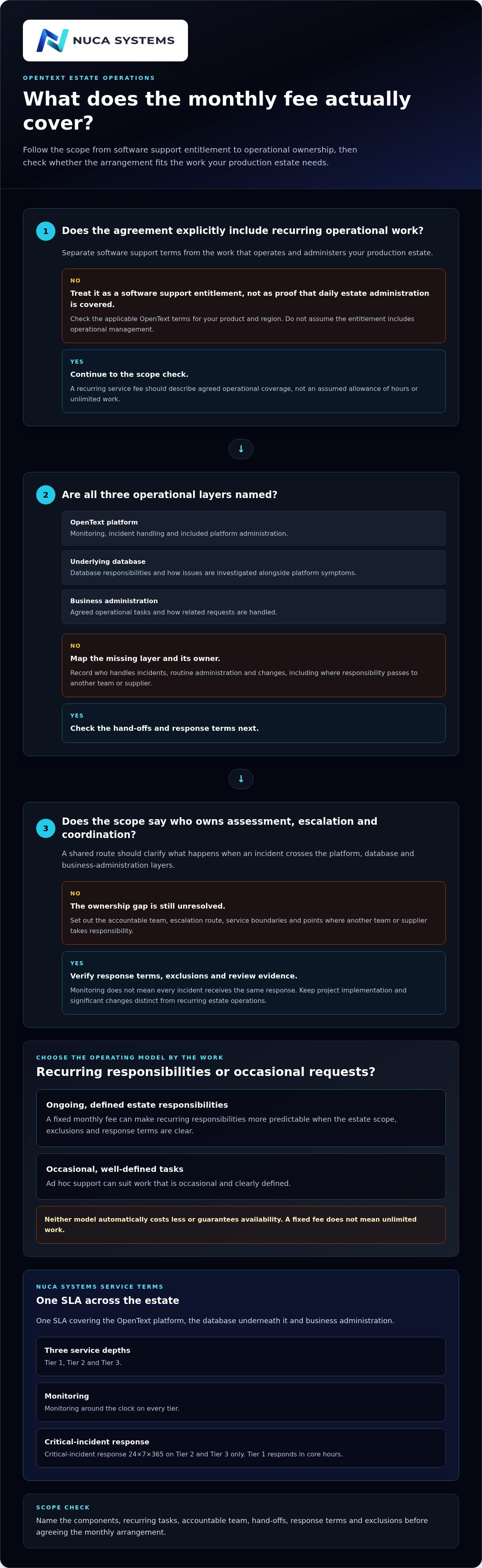
Assess the estate, not just the product name on a support agreement. Map the production platform, the database underneath it and the business-administration layer. Then record who handles incidents, routine administration and changes. If responsibilities cross internal teams or suppliers, document the hand-off points in the service scope.
Does an OpenText software support contract cover estate administration?
Don't assume that vendor software support includes day-to-day administration of your environment. Software support terms and operational management are separate buying decisions, with different responsibilities. The applicable OpenText terms for your product and region define the software support entitlement. Check those terms and the relevant OpenText release notes rather than generalising from material for another region or product.
Operational work can span several owners. One team may administer the OpenText platform, another may own the database, and business administrators may manage users, permissions or process configuration. When an incident crosses those boundaries, the practical question is who coordinates diagnosis and action. A retainer should make that ownership clear, rather than leaving each team to assume another will take the lead.
What does an OpenText managed service fee describe?
A managed service fee describes recurring operational coverage for a defined production estate. It should set out the components in scope, included activities, response terms and exclusions. It is not automatically an allowance of hours, and a fixed fee does not mean unlimited work. Distinguish project implementation and significant changes from recurring estate operations so that neither is mistaken for the other.
Nuca offers three service depths, Tier 1, Tier 2 and Tier 3. Its model uses one SLA covering the OpenText platform, the database underneath it and business administration. The exact terms are: monitoring runs around the clock on every tier; critical-incident response 24×7×365 applies to Tier 2 and Tier 3; Tier 1 responds in core hours. The useful test is whether the named team owns the operational work you need covered, including the points where the platform, database and business administration meet.
Which work should an OpenText monthly retainer cover?
Start with the production estate and list responsibilities by layer. This makes gaps visible before an incident forces teams to work them out under pressure. Name the components covered, the recurring tasks attached to them and who owns the next action when work crosses a boundary.
Which OpenText estate responsibilities belong in the agreed scope?
- OpenText platform: define monitoring, incident handling and resolution, and the platform administration included in routine operations.
- Underlying database: state which database responsibilities sit within the arrangement and how database issues are investigated alongside platform symptoms.
- Business administration: identify the agreed operational tasks for the business-administration layer, including how related requests are handled.
Then record how patching and upgrade readiness are handled. Clarify what preparation and operational coordination form part of recurring stewardship, and where a separately scoped project begins. Software implementation projects and licence reselling are distinct from ongoing estate operations. Make that boundary explicit rather than leaving it implied in the retainer.
How should the SLA define accountability across components?
One SLA can give teams a shared route for ownership across the platform, database and business administration. It should name the accountable team for initial assessment, escalation and coordination, then show where another team or supplier takes responsibility. Set out service boundaries and response terms explicitly. Don't assume that monitoring means every incident receives the same response.
Nuca's own terms work this way: monitoring is the same on every tier, and the tier decides the critical-incident response, as set out above. The scope is tailored to the estate and selected service depth. Check that the agreed responsibilities reflect your production components and hand-offs, rather than relying on a generic task list.
The purpose is not to remove every specialist team. It is to prevent an incident from sitting between teams without an owner. When the platform, database and business-administration layers share an SLA, the agreement can clarify the route from detection to escalation while still defining what falls outside the operational arrangement.
Fixed monthly fee or ad hoc OpenText support: what changes?
The useful comparison is operational, not just financial. A fixed monthly fee sets recurring coverage around an agreed estate scope. Ad hoc support is engaged for defined requests or incidents. Neither model automatically costs less or guarantees availability. The right fit depends on how often operational work arises, who owns it and how much continuity your production estate needs.
| Area | Fixed retainer | Ad hoc support |
|---|---|---|
| Scope | Recurring work is defined against the estate and service depth. Exclusions and project boundaries should be clear. | Work is agreed as requests arise. Routine tasks may sit outside an individual engagement. |
| Ownership | An SLA can assign an accountable team across the agreed components and escalation path. | Ownership is typically agreed for each request, so cross-team coordination may need separate attention. |
| Planning | Recurring operational responsibilities can be planned within the agreed scope. | Work is arranged as needs arise, which can suit tasks that are occasional and well defined. |
| Continuity | A standing arrangement can provide a consistent route for in-scope work, subject to its response terms. | Continuity depends on how each engagement is scoped and how operational context is recorded and handed over. |
When does a fixed-fee OpenText service fit an estate?
We find a standing arrangement is worth assessing when monitoring, maintenance or incident coordination recur, particularly where platform and database ownership are split. Match the service depth to the estate's components and the responsibilities written into its SLA. Judge the OpenText support monthly fee by that agreed coverage, not by an assumption that every task is included or that unused capacity is refunded.
It can also help to define what remains project work. Routine operational stewardship and a separately scoped implementation are different kinds of work. Make that boundary explicit before comparing proposals.
When might ad hoc support leave an ownership gap?
Ad hoc support can suit a discrete request with a clear owner and outcome. But an incident-led engagement may address the immediate fault without covering routine monitoring or maintenance between requests. For example, a platform alert may require a database check. If each team handles only its assigned component, someone still needs to coordinate the investigation and track the hand-off.
That does not make ad hoc support unsuitable. It means the model should match the estate's operating pattern. Compare the responsibilities, planning needs and continuity arrangements you require, not the fee labels alone.
How can you assess an OpenText monthly fee before agreeing scope?
Use evidence from the production estate, not assumptions about what a retainer usually includes. Map the components, identify current owners, define the service depth, record response terms and review the supporting evidence. This makes it easier to compare a proposed OpenText support monthly fee with the work your teams perform and the hand-offs they manage.
What evidence should support the proposed service scope?
Start with the estate inventory and operational records. Check which OpenText platform components and database instances are in production, who administers business processes, and where incidents or routine tasks move between teams. Separate recurring work shown in those records from assumptions about future incidents, patching needs or upgrades. If ownership is unclear, record that as a boundary to resolve, not as an agreed responsibility.
| Responsibility | Current owner | Proposed owner | Agreed boundary |
|---|---|---|---|
| OpenText platform operations | Record the team currently responsible | Name the team taking responsibility | List included recurring tasks and exclusions |
| Underlying database operations | Record the database owner | Name the proposed owner or escalation contact | Clarify where database work transfers to another team |
| Business administration | Record the current administrator or team | Name the proposed owner | Define which business-administration tasks are covered |
| Incident coordination and escalation | Record who coordinates today | Name the accountable team | Document escalation ownership and response terms |
Use the table to expose gaps before agreeing scope. Confirm that each proposed responsibility has an owner and a boundary. Don't add assumed usage volumes, response targets or performance improvements where there is no evidence.
How should Tier 1, Tier 2 and Tier 3 be compared?
Compare each service depth against the responsibilities your estate needs assigned, then check the response terms rather than inferring them from the tier name. On Nuca's tiers the difference is the critical-incident response: around the clock on Tier 2 and Tier 3, core hours on Tier 1, with monitoring running on all three. Record the selected depth and its scope in the service agreement.
Review the proposed coverage alongside your inventory, incident records and ownership map. OpenText estate health: 15 checks worth running is a structured reference for reviewing the estate yourself. Use findings that are relevant to the scope under discussion. The decision should follow documented responsibilities and hand-offs, not a label alone.
How Nuca Systems structures OpenText managed services
Nuca Systems is an independent specialist managed service provider for OpenText estates. Its fixed monthly fee is scoped to the customer's production estate and agreed operational responsibilities. The service is delivered by senior-led, named engineers rather than through a ticket queue. It covers ongoing estate operations, not a software licence entitlement, and does not mean unlimited work or a guaranteed outcome.
What distinguishes Nuca’s operating model?
The arrangement has three depths, Tier 1, Tier 2 and Tier 3. The selected depth sets the service terms for the estate, while one SLA covers the OpenText platform, the database underneath it and business administration. This gives the three layers a shared accountability framework, with one team responsible for the agreed scope rather than leaving the customer to coordinate every operational hand-off.
Monitoring and incident response are distinct parts of the service. Monitoring runs on every tier; the selected tier determines the critical-incident response terms, as set out earlier in this article.
Nuca brings 14+ years on Content Server, Archive Center and Extended ECM. The service scope is still defined against each estate, its components, ownership boundaries and recurring responsibilities. To assess an OpenText support monthly fee, check whether the written scope matches the production work you need covered and whether the SLA makes accountability clear.
Managed services remain separate from OpenText software support entitlements. The operational arrangement concerns stewardship of the customer estate, while the applicable OpenText terms govern the separate software support relationship.
What is the next step if the fee model fits?
Bring the production component list, current ownership map and known hand-off points to a 45-minute continuity check call. You describe the estate and how it is supported today; we say whether a standing arrangement would change anything. If it would not, we say so.
Set the scope before choosing the fee model
An OpenText support monthly fee should be judged by the work and accountability it defines, not by the label alone. Compare fixed-fee and ad hoc arrangements against your production responsibilities, recurring operational needs and hand-offs between the platform, database and business-administration teams. Make scope, service depth and response terms explicit before agreeing an arrangement.
Nuca's managed services use one SLA covering the OpenText platform, the database underneath it and business administration. The fit depends on whether that defined coverage matches the way your estate is run.
Use the questions below to check that the arrangement addresses the operational work and ownership boundaries that matter to your estate.
Frequently asked questions
Related reading