
Content Server managed services
Content Server managed services for estates already in production
Content Server holds the documents and records wrapped around processes people reach through SAP and other line of business systems. When it slows, when search drifts, when OTDS pools fail quietly, the business feels it before the dashboards do.
Nuca supports OpenText estates across the UK, Ireland, DACH and the wider EU. We run live Content Server estates as an ongoing managed service. Monitoring, patching, incident response, performance diagnosis, backup verification and change control, with the database underneath treated as part of the same problem, not a separate ticket queue. Platform, business and database administration sit under one coordinated support model, with one accountable team and a fixed monthly fee scoped to your estate.
We are not an implementation partner and we are not a generic helpdesk. We do not rebuild your estate. We keep the one you have stable in production, alongside your specialists rather than instead of them. If your only Content Server expert is about to leave, start with interim cover. If the estate needs a standing service, start with platform depth and grow only if you need it.
If a second pair of eyes would help, book a free 45-minute continuity check call.
What day to day run actually needs
A live Content Server estate needs more than a ticket when something breaks. Day to day run means someone is watching the platform and the database underneath it, catching drift before users feel it, and owning the diagnosis when a fault sits across both. It means patching on a controlled cadence, verifying that backups can actually restore, and treating change control as part of the same service rather than a separate project.
Most estates already have specialists for parts of this. The gap is usually the work that falls between platform, database and infrastructure teams: OTDS pool behaviour that looks fine until authentication fails, search that degrades month by month, or a save that is slow while storage reports look clean. That is the operational support model a business-critical Content Server estate needs around it, whether the cover comes from your own team, from Nuca, or from both working together.
Platform work we take: Content Server, OTDS, search, agents, change control
On the OpenText platform itself we administer Content Server and the services that keep it honest in production. That includes OTDS, search, agents and the routine change control that stops a quiet configuration drift from becoming an outage. Monitoring and alerting run around the clock. Patching and version currency sit in the same plan as incident ownership, so the person who sees the alert is also the person who can act.
We stay close to the joins that affect how people reach content: authentication through OTDS, browse and search behaviour, and the agents that move work through the estate. When a change is needed, we document it, schedule it, and verify the result against the live estate you already run.

The database underneath Oracle and SQL Server workloads
Content Server does not run in isolation from its database. Oracle and Microsoft SQL Server workloads under OpenText are part of the same production story: connection pools, statement behaviour, backup verification and recovery readiness. We treat the database underneath as in scope for OpenText workloads, not as a handoff to a separate queue that never sees the application symptom.
When saves are slow, when authentication clears on restart, or when a clean database report still leaves the application struggling, the evidence often sits across both layers. One accountable team looks at both. For a deeper read on how we think about that layer, see OpenText ECM database administration. We do not take on generic database administration for non-OpenText workloads.

Incidents that sit between application and database
The incidents that stay open longest are rarely owned cleanly by one team. A Content Server symptom can point at the application, at OTDS, at the database round trips underneath, or at the infrastructure path between them. Each team can correctly say that its own layer looks fine. The estate still hurts.
Nuca is built for those cross-layer faults. We diagnose once, across platform and database, under one coordinated support model. Critical-incident response follows the tier you choose: core hours on Tier 1 Platform, and 24×7×365 response for critical incidents on Tier 2 and Tier 3. Monitoring and alerting run around the clock on every tier. We work alongside your specialists, not in place of them.
How this sits next to OpenText vendor support and Current Maintenance
Nuca does not replace OpenText as the product vendor. OpenText vendor support and Current Maintenance remain the path for your licences and releases. What Nuca takes is the day to day run of the live Content Server estate: monitoring, patching, incident ownership, backup verification, and the joins between Content Server, OTDS and the database underneath.
When a release nears the end of its Current Maintenance period, production still needs a clear operational owner while you decide whether to stay, upgrade or bridge. For dates that apply to your release, use OpenText's published lifecycle materials rather than anything restated here. For estates on older releases, OpenText support for legacy versions is a useful companion read.
Service depth in brief, and when interim cover is enough
| Tier | What it covers on a Content Server estate | Response |
|---|---|---|
| Tier 1 Platform | Platform and database kept production-stable. Monitoring and alerting around the clock. | Critical-incident response in core hours. |
| Tier 2 Platform + Business | Everything in Tier 1, plus the business-administration layer. | Critical-incident response 24×7×365. Monitoring around the clock. |
| Tier 3 Full Lifecycle | Everything in Tier 2, plus full lifecycle: upgrades, migrations and a named Technical Account Manager. | Critical-incident response 24×7×365. Monitoring around the clock. |
Every tier includes around-the-clock monitoring. Choose Tier 1 Platform when business administration is already covered in house. Choose Interim Cover when you need temporary administrator capacity only: three-month minimum, then rolling monthly. The managed service is a fixed monthly fee scoped to your estate. Full service detail sits on OpenText managed services. Vacancy cover detail sits on Interim OpenText administrator cover.
What we do not do: implementations, custom build, greenfield
On this page, we mean running live Content Server estates that are already in production. We do not sell greenfield OpenText implementations. We do not take custom build or AppWorks projects. We do not run large multi-product integration programmes. Those stay with the people built for them, including OpenText Professional Services and systems integrators where that is the right fit.
We also stay out of end-user device support and generic infrastructure beyond what directly affects the OpenText estate. Your implementation partner keeps the build relationship. Your specialists keep their domains. We take the operational run so the estate stays stable after go live, on-premise or private cloud.
Check the estate yourself, then book a free 45-minute continuity check call
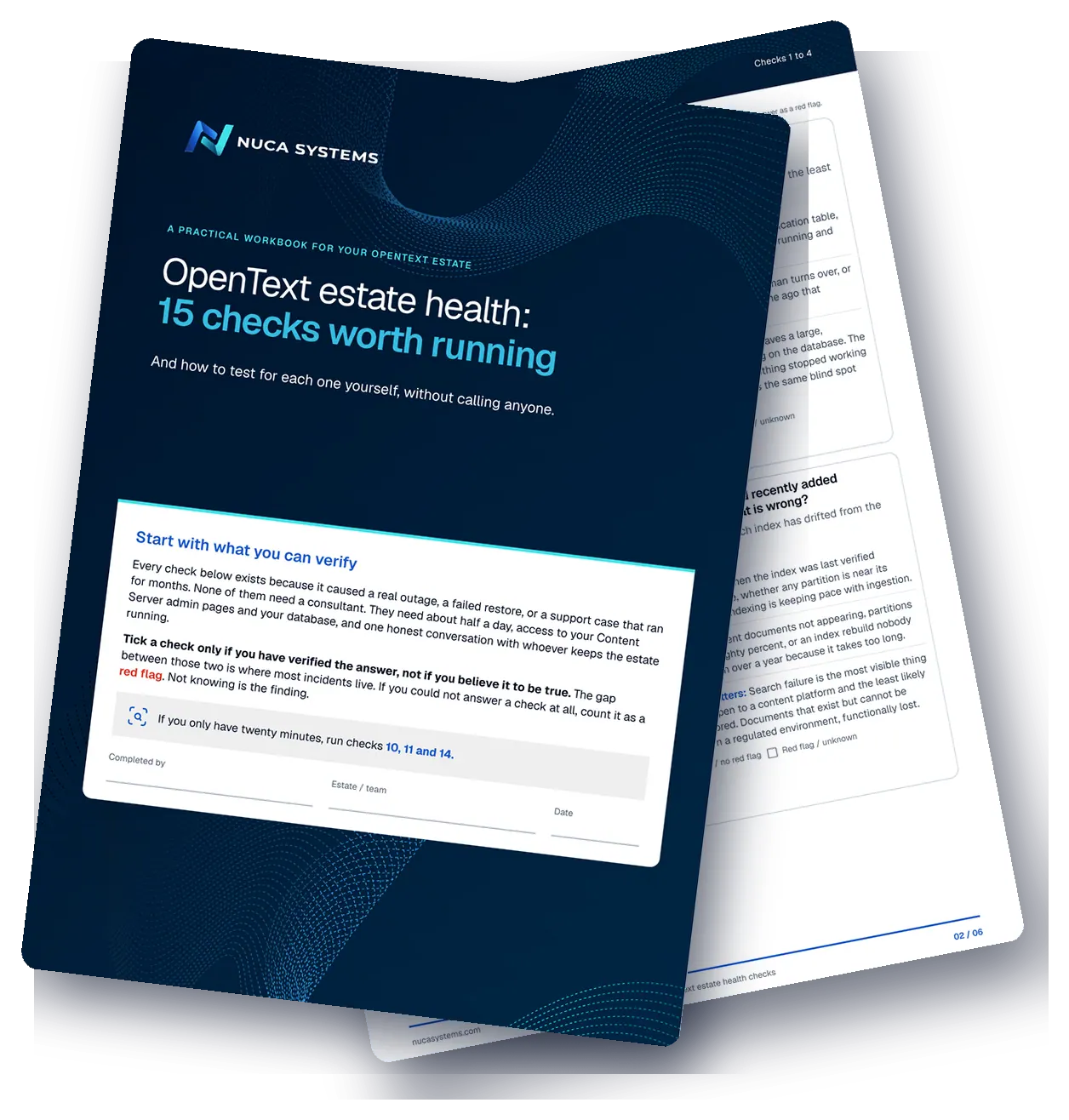
If you want a structured self-review first, use the 15 estate self-checks. They are a free self-check resource, not a Nuca review, and you can run them without us.
If you want the findings in writing after a conversation, the Estate Continuity Review is the paid next step: two weeks on your live Content Server estate, five senior days, review only, fixed price agreed in advance and credited against the work that follows. Start with the free 45-minute continuity check call (no system access, no log upload) via book a free 45-minute continuity check call.
Further reading: OpenText Content Server 26.2 plain English guide, OpenText support for legacy versions, and OpenText ECM database administration. For slow-estate symptoms, see OpenText estate performance. For Extended ECM estates, see Extended ECM and xECM support.
FAQ
If a second pair of eyes would help, book a free 45-minute continuity check call.
No system access and no log upload. For a self-review first, use the 15 estate self-checks. No other meeting ask.